
A scar is rarely just a physical mark where an injury once occurred. For many individuals, long after a wound has closed, the resulting scar remains a daily emotional burden or a physical obstacle that restricts natural movement and draws unwanted attention.
Treating scars, burn injuries, and deep tissue trauma requires far more than over-the-counter creams or basic aesthetic procedures. Scar tissue lacks normal elasticity, has an altered blood supply, and often contracts unpredictably over time. Achieving meaningful improvement demands the specialized training of a reconstructive plastic surgeon who understands complex tissue behavior, tension lines, and advanced wound healing.
At Purple Heron Hospital in Jaipur, Dr. Nitesh Lamoria combines superspecialty reconstructive expertise with modern microsurgical technology to restore both functional mobility and aesthetic balance.
Here is what you need to know about different types of scars, how modern reconstruction works, and why the right surgical approach makes a lasting difference.
Why Scars and Burns Need a Plastic Surgeon's Approach, Not Just Skincare
Scar tissue behaves differently from normal skin it's less elastic, doesn't have the same blood supply, and can continue to tighten or thicken for months after a wound closes. That's why skincare products and generic advice ("just apply this cream") often fall short for anything beyond a minor scar. Reconstructive plastic surgery training specifically covers how tissue heals, how to redirect a scar's tension lines, and how to bring in healthy tissue when the original area can't heal well on its own skills that go well beyond cosmetic technique.
This matters more for burns and trauma-related tissue damage than for an average scar. Burns can destroy multiple layers of skin and, in more severe cases, the tissue underneath. Treating that properly requires understanding reconstruction, not just appearance.
Types of Scars and Burn Damage and How Treatment Differs
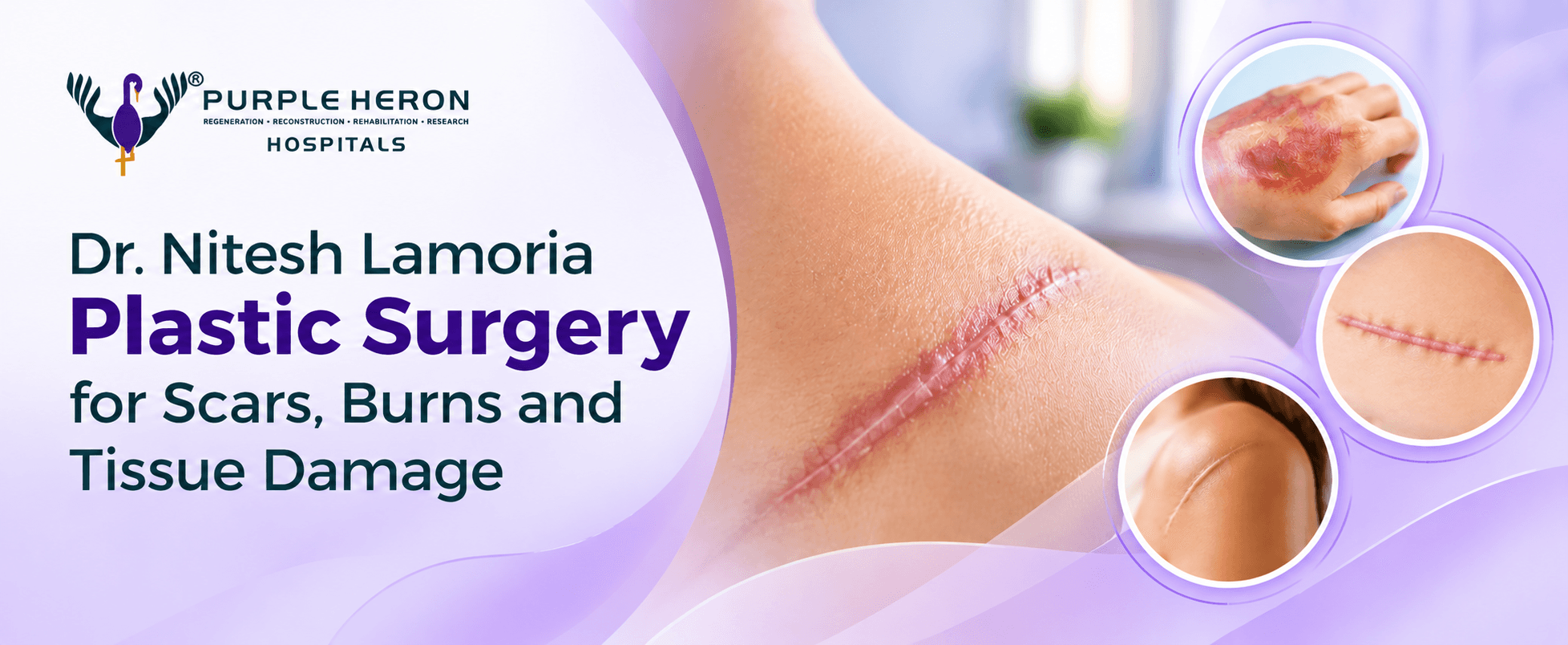
Not all scars heal the same way, and their depth, location, and tissue structure determine the appropriate medical approach. While some scars merely cause cosmetic concern, others can restrict joint flexibility or lead to chronic tightness, requiring specialized reconstructive techniques to restore normal skin function and appearance.
Hypertrophic and Keloid Scars
These are raised, thickened scars caused by excess collagen during healing. Hypertrophic scars stay within the boundary of the original wound; keloids grow beyond it. Treatment often starts non-surgically steroid injections, silicone sheeting, pressure therapy and moves to surgical excision only if these don't sufficiently improve the scar.
Contracture Scars
When a scar tightens skin and underlying tissue together, it can restrict movement particularly problematic when it crosses a joint like the elbow, knee, or neck. Unlike purely cosmetic scars,
contractures often need surgical release (sometimes with skin grafts or tissue flaps) sooner rather than later, since restricted movement can worsen the longer it's left untreated.
Burn Scars
Burn injuries vary hugely in depth and severity, and the resulting scar reflects that. Superficial burns typically heal with minimal scarring; deeper burns can leave scarring that affects both appearance and function. Reconstructive treatment ranges from scar revision and skin grafting to more complex tissue transfer for severe cases, and is often staged across multiple procedures over time as the scar settles.
Post-Surgical and Trauma Scars
Scars from a previous surgery, an accident, or a laceration are generally the most straightforward to revise, since the surrounding tissue is usually healthy. Techniques here focus on repositioning the scar along natural skin lines and minimizing width and visibility.


Dr. Nitesh Lamoria's Approach to Scar and Burn Reconstruction
Dr. Nitesh Lamoria holds an MBBS, MS (General Surgery), and MCh in Plastic, Reconstructive & Cosmetic Surgery from SMS Medical College, Jaipur, and is Director & Founder of Purple Heron Hospitals. That progression through general surgery before the plastic surgery superspecialty is directly relevant to scar and burn cases it's the training pathway built around trauma and reconstruction, not cosmetic refinement in isolation.
His broader approach, applied across his practice, centres on treating each case according to the individual's actual anatomy and tissue condition rather than a standard protocol, and on using the smallest, most precisely placed intervention that achieves a genuine improvement an approach that matters especially in scar work, where an unnecessary or poorly planned procedure can leave a second scar without meaningfully improving the first.
Purple Heron Hospital's surgical facilities including modular operating theatres and Zeiss microsurgical equipment also matter for more complex reconstructive cases, where tissue transfer or microsurgical repair may be needed alongside standard scar revision.
What to Expect: Consultation to Recovery Timeline
A proper evaluation for scar or burn reconstruction starts with understanding the scar's type, age, and whether it's causing any functional restriction, not just how it looks. From there, a plan is built which may be entirely non-surgical, primarily surgical, or a staged combination of both depending on severity.
Recovery timelines vary considerably by procedure. Simple scar revisions often allow return to normal activity within one to two weeks, with the visible result continuing to refine over several months. More complex reconstructive work involving grafts or tissue flaps has a longer recovery and may be staged across multiple surgeries spaced months apart to let each stage heal fully before the next.
Is It Too Late for Scar Revision?
A common misconception is that scar revision only works soon after an injury, or conversely, that it's pointless once too much time has passed. Neither is accurate. Most scars actually need close to a year to fully mature before revision surgery is appropriate operating too early, before the scar has settled, can produce a less predictable result. On the other side, scars from years or even decades ago can still be candidates for revision, since scar tissue doesn't "expire" the main exception is contractures restricting movement, which are often addressed sooner because delaying can allow the restriction to worsen.
Choosing the Best Plastic Surgeon in Jaipur for Scar and Burn Reconstruction
Scar and burn work sits at the more technically demanding end of plastic surgery, which makes the choice of surgeon more consequential than for most cosmetic procedures. When evaluating plastic surgery in Jaipur for a scar, burn, or tissue damage concern, a few things are worth checking specifically: whether the surgeon's qualification includes an MCh in Plastic, Reconstructive & Cosmetic Surgery (not a shorter certification course), whether they have documented experience with reconstructive and trauma cases rather than cosmetic procedures alone, and whether the facility has the surgical infrastructure including microsurgical capability to manage complex cases without referring elsewhere mid-treatment.
If you're dealing with a scar, burn scar, or tissue damage that's affecting how you look or move, chat with our care assistant for quick guidance and support a short conversation can help clarify what kind of scar you're dealing with and whether a consultation is the right next step.